CERN/Zenodo:
AI governance cannot stop at the request or the tool call. In distributed inference, the model's Key-Value (KV) cache moves between memory tiers and across nodes; that state can shape later outputs and must remain inside the trust boundary.
Zero-Trust Cold Pages (ZTCP) was developed at Theseus Guard as a storage- and transport-boundary extension of the Zero-Trust AI Data Plane (ZT-ADP), L1 Precedent Decision Cache, and DREP (Detect–Route–Enforce–Prove) lifecycle. At the cold-page boundary, it combines RoPE-preserving quantization with ChaCha20 encryption and SipHash-2-4-128 authentication, while leaving active GPU Attention KV in its native precision.
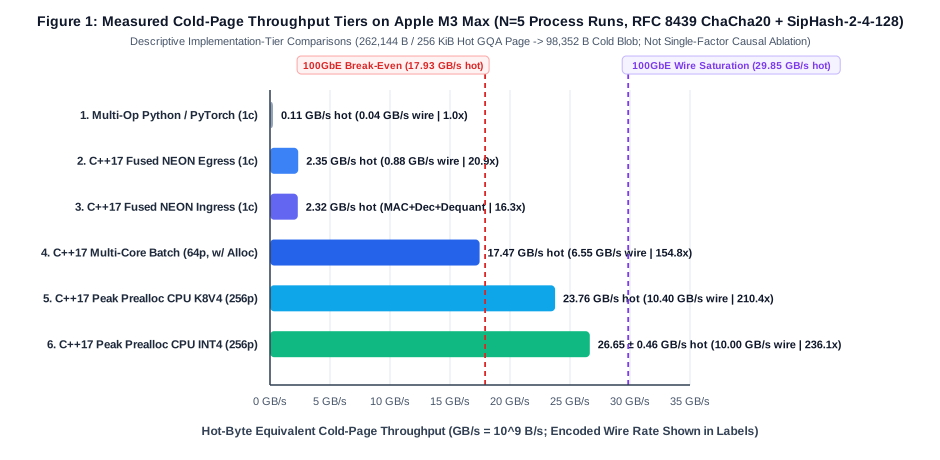
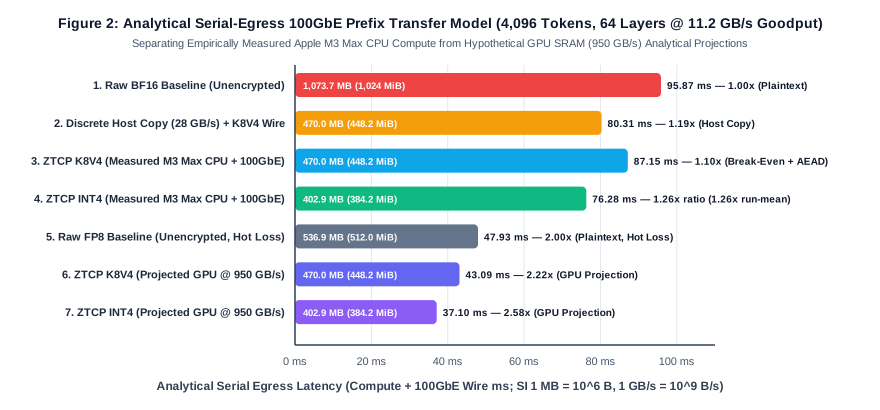
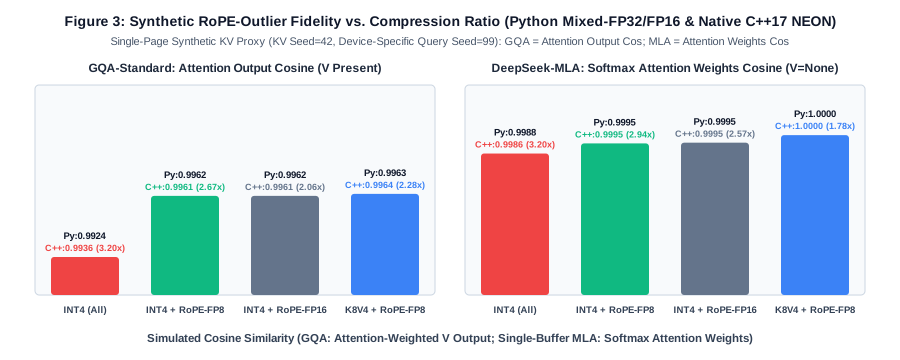
The paper evaluates three parts of this idea: codec throughput, modeled transfer latency, and attention fidelity after quantization.
Carrying a governance decision with the cache
The paper describes how that connection works architecturally: the pre-provider gate binds the tenant and guard-snapshot identity into each page's authenticated metadata. On return, a page that fails identity, authentication, or freshness checks is blocked from hot memory and sent for clean prefix recomputation. If post-provider TG-Sentinel:G1 evaluation or session-risk tracking convicts a session, its keys can be cryptographically shredded, rendering its offloaded pages unreadable.
The governance contribution is this link between a runtime verdict and the integrity, reuse, and lifecycle of the model state behind subsequent decisions. It extends the DREP control path into distributed KV-cache handling instead of treating that infrastructure as outside governance.
The paper presents an integration architecture, while the public artifact verifies the CPU codec, in-process session keyring, and Python/CPU hooks. It does not report a live RDMA deployment, hardware TEE attestation, or an end-to-end production validation of the DREP integration. Read the ZTCP paper and explore the implementation.